
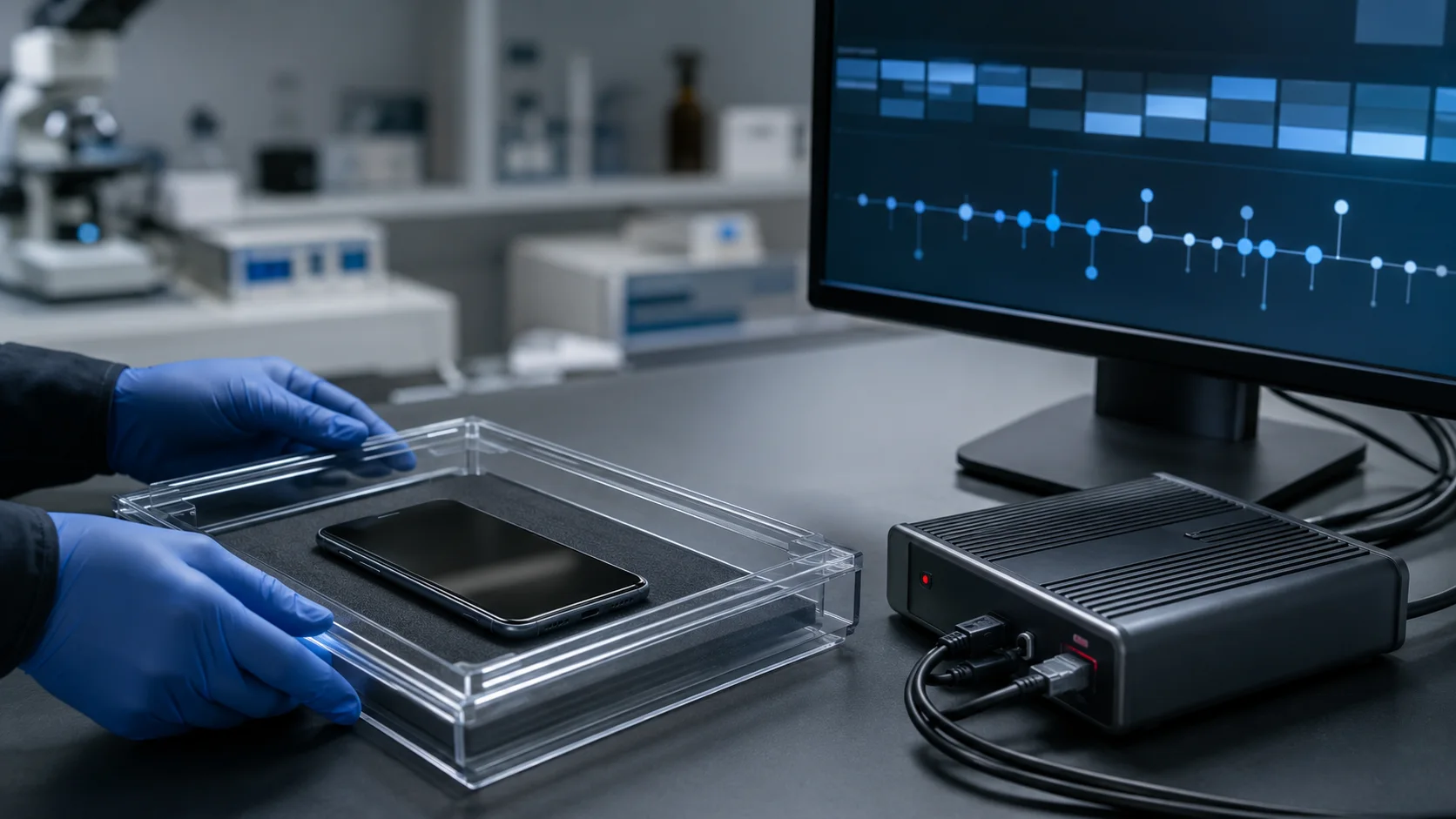
Cell-site records can show that a device communicated with a network through a tower or sector at a particular time. Coverage depends on geography, terrain, network design, device behavior, congestion, and the record type. A tower connection is not a GPS point and does not automatically prove who carried the phone. Strong interpretation identifies the data source, precision, assumptions, and independent corroboration.
What to remember
- A tower record usually describes network connection, not a precise device location.
- Sector, terrain, congestion, handoffs, and network design affect the possible area.
- The phone may be separated from its owner or used by another person.
- Maps should show uncertainty rather than a single confident dot.
- Location evidence should be combined with timestamps, devices, witnesses, and records.
What a cell-site record is
When a phone places a call, sends a message, uses data, or registers with a network, the provider may record network events. Depending on the request and jurisdiction, records can include tower, sector, time, call detail, device identifier, or more specialized location data. They are not all equivalent.
A basic call-detail record may show which tower and sector handled an event. That can help test whether a device was consistent with a broad area. It normally cannot place the phone at a specific address or prove that the user was holding it.
Why the tower is not a pin on a map
A tower serves an area shaped by antennas, terrain, buildings, weather, network load, and neighboring cells. A sector may cover several roads or neighborhoods. Phones can connect to a non-nearest tower because of capacity, signal conditions, or network engineering.
A map that draws a circle around a tower is an illustration, not a measurement of the device’s exact path. Analysts should state the possible area, the data limitations, and whether the event is consistent with competing locations.
Different records provide different precision
Historical cell-site records are different from GPS, Wi-Fi positioning, handset application data, or provider-generated location estimates. A specialized request may contain timing or signal information that improves analysis, but it still depends on validation and assumptions. The document should identify the system and fields actually used.
A precise-looking timestamp can also mislead. Timezones, daylight-saving changes, network clocks, and the difference between event creation and delivery may matter. Analysts should normalize time and explain uncertainty rather than treating every timestamp as self-evident.
The phone is not the person
A device can be left behind, shared, stolen, automated, or controlled remotely. A location record may support that a phone was in an area; it does not by itself identify who carried it or what they did there. Ownership records are not the same as possession at the relevant time.
Investigators should compare location evidence with surveillance, access logs, transport records, purchases, messages, biometrics, and witness accounts. Contradictions should be reported. A location clue is useful when it narrows a question, not when it is treated as an invisible witness.
How lawyers and courts test location evidence
Questions include who collected the records, whether the provider’s system is accurately described, whether the requested time range is complete, what coverage existed, and whether an alternative location would also fit. The expert should disclose methodology, assumptions, error, and any data excluded.
The legal standard for admissibility and weight varies. A chart can make complex data readable, but it must not hide the uncertainty. Labels such as ‘near’ or ‘in the area of’ are often more accurate than ‘at the scene.’
How to report cell-site evidence responsibly
State what the record can establish and what it cannot. Avoid the phrase ‘phone pinged a tower’ when the data describes a routine network event, and avoid a single-dot map that suggests GPS precision. Link to the underlying filing or expert explanation where possible.
For families and readers, the most useful question is usually whether the record changes the timeline. That answer can be meaningful without pretending that a phone record reconstructs every movement.
Questions people ask
Can cell records prove someone was at a house?
Usually not by themselves. They may show a device used a network resource serving a broad area. Other evidence and the specific record type are required.
Does the nearest tower always connect?
No. Network engineering, signal conditions, congestion, and terrain can lead a phone to use another tower or sector.
Can a phone location prove who used it?
No. A device can be shared or separated from its owner. Possession must be supported by independent evidence.
Is GPS always exact?
GPS can be more precise but still has error, device, environment, and data-quality limitations. It also shows a device, not automatically a person.
Research note: TruthTube prioritizes government publications, primary records, scientific standards, and official reporting channels. This article is educational and does not replace legal, financial, medical, or psychological advice.
This article was researched using official records, regulator notices, court documents, law-enforcement releases, provider documentation and reputable reporting. Material claims were checked against the cited sources.
AI tools may have assisted with research organization, language refinement, transcription or illustration, but factual claims were reviewed by Lavi, Founder & Editorial Lead.
Published July 13, 2026. This page is scheduled for review when official guidance, reporting channels, scientific standards, or relevant laws change.