Digital forensics is the disciplined recovery, preservation, examination, analysis, and reporting of data from devices and systems. Phones may contain messages, call records, photos, application data, locations, account artifacts, and metadata, but access and completeness vary. A timestamp does not automatically prove who performed an action, a deleted item may not be recoverable, and a screenshot is not equivalent to validated source data. Strong conclusions depend on chain of custody, forensic acquisition, tool testing, corroboration, and clear limits.
What to remember
- Digital evidence is often a record of a device or account, not direct proof of the human actor.
- Preservation seeks to avoid altering the original and to document every handling step.
- Metadata needs context: clock settings, time zones, synchronization, application behavior, and server records can matter.
- Deleted does not mean recoverable, and recovered does not always mean complete.
- Screenshots are useful leads but should be authenticated against original data where possible.
What digital forensics actually does
Digital forensics applies tested methods to data that may be relevant to an investigation. NIST describes mobile-device forensics as recovering digital evidence under forensically sound conditions using accepted methods. The work can involve computers, phones, vehicles, cameras, cloud services, networks, wearables, drones, and embedded systems.
The process is broader than opening a device and reading messages. Examiners identify potential sources, preserve them, acquire data, validate results, analyze artifacts, document methods, and report both findings and limitations. Legal authority and scope determine what may be collected and searched.
Forensics does not turn every device into a complete diary. Encryption, damage, account settings, application design, retention, remote storage, overwritten data, and unavailable credentials all shape what can be recovered.
Preservation, chain of custody, and the original evidence
Digital data can change through ordinary use. A device may receive messages, update applications, synchronize with cloud services, rotate logs, or change time values. Preservation aims to limit alteration while documenting the state and every person who handled the item.
Chain of custody records collection, transfer, storage, access, and examination. A gap does not automatically make evidence false, but it can create questions about integrity and attribution. Photographs, seals, identifiers, hashes, and logs may support the record.
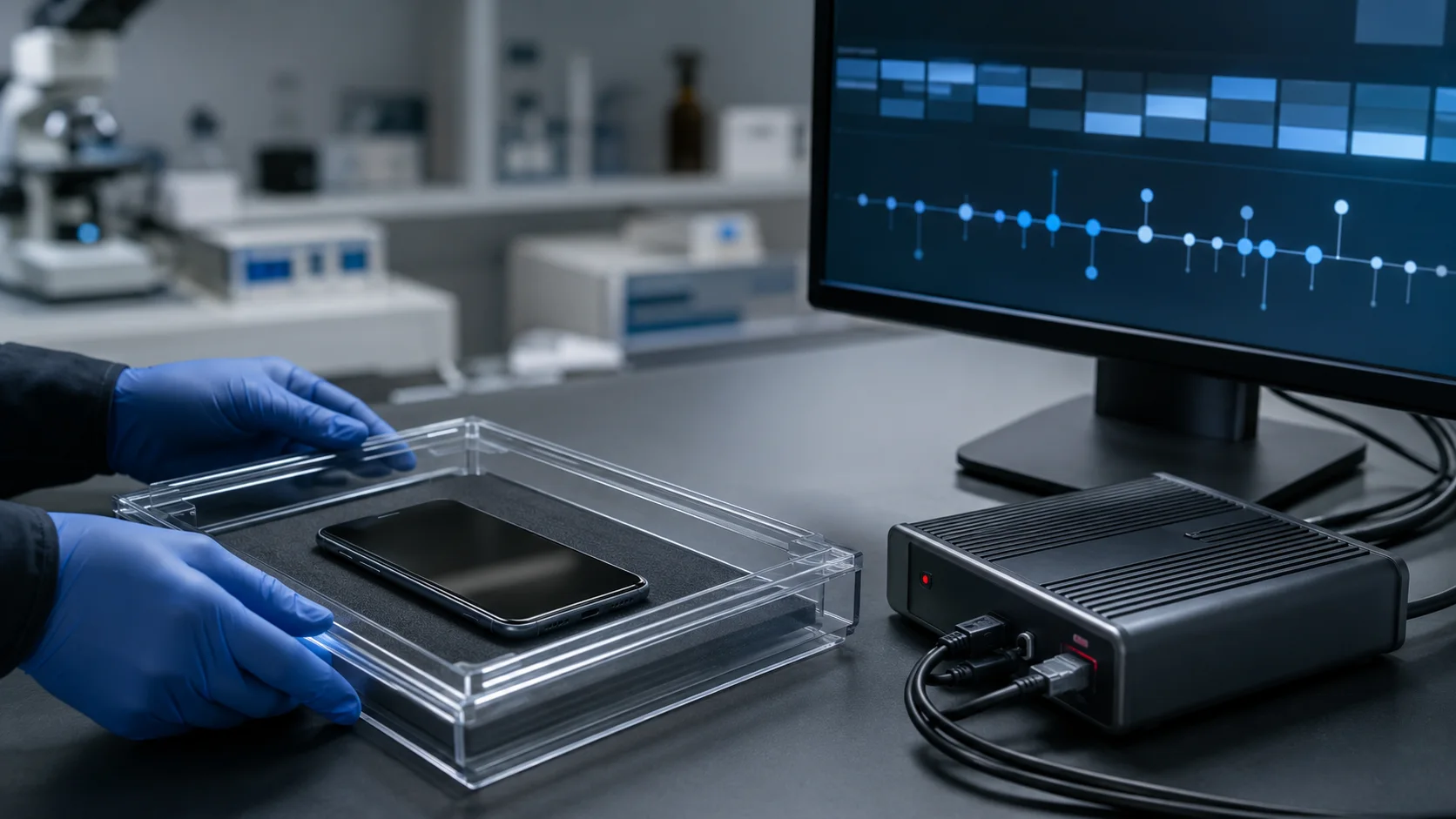
Examiners commonly work from a forensic acquisition or validated copy rather than repeatedly exploring the original. The appropriate method depends on device, authority, condition, and investigative need. Reporting should state what was collected and what was not.
What a phone may contain
A phone can contain user-created content, application databases, system logs, cached material, media, contacts, account identifiers, browser history, network information, and location-related artifacts. Some data lives primarily in cloud accounts or provider systems rather than on the handset.
The presence of an application does not prove use in a specific event. A contact record does not prove communication. A photo on a device may have been received automatically, restored from backup, or created elsewhere. Each artifact needs source and context.
Application updates can change storage formats. Two devices using the same app may retain different information because of operating system, settings, backup, or time since use. Claims should be tied to the actual extraction and validation, not assumptions about what phones usually contain.
What messages can—and cannot—prove
A message record can support that content was associated with an account or device at a recorded time. Original databases or provider records may include sender and recipient identifiers, status, attachments, and technical fields that a screenshot omits.
Attribution remains separate. Accounts can be shared or compromised; devices can be borrowed; messages can be forwarded; contact names can be edited. A message displayed under a familiar name is not proof that the saved person authored it.
Conversation context matters. Cropped threads can omit earlier statements, replies, edits, or platform notices. Investigators compare device data, provider returns, account access, other devices, witnesses, and surrounding events.
Metadata: powerful context, not a magic answer
Metadata is information about data: timestamps, file type, device or application fields, dimensions, coordinates, account identifiers, or processing history. It can help organize events, connect files, and test claims.
Timestamps require careful interpretation. A value may represent creation, modification, upload, server receipt, local display, or database entry. Time zones, daylight saving, incorrect clocks, imports, exports, and application behavior can change what a displayed time means.
Location metadata can be precise, approximate, stale, user-entered, or absent. A device location does not always prove a person’s location. Strong analysis identifies the source, expected accuracy, and corroborating records.
Digital artifacts frequently describe what a device, account, or service recorded. Human attribution requires additional evidence.
Does deleted data really disappear?
Deletion behavior varies. An application may mark a record for removal while fragments remain until overwritten; another may encrypt or purge it immediately; a cloud backup or recipient’s device may retain a copy. Modern storage and encryption can make older assumptions about recovery unreliable.
Recovered fragments may lack context or be duplicated. A keyword hit is not a complete conversation. Examiners validate whether an artifact is active, deleted, cached, carved, synchronized, or derived from another source.
Consumers should not assume deleted content is recoverable, and investigators should not imply that absence proves an event never occurred. The defensible statement is limited to what the examined sources and methods revealed.
Why forensic tools need testing and human review
Tools automate extraction and parsing across thousands of formats. They can save enormous time but may mislabel, omit, duplicate, or incorrectly interpret data when software changes. NIST’s testing programs and scientific-foundation work emphasize validation and understanding of method limits.
Examiners compare results, review raw structures when necessary, test known data, and document tool versions and settings. A colorful report is not self-authenticating. Interpretation belongs to a qualified human who can explain how the result was produced.
Peer review and reproducibility strengthen conclusions. If another examiner cannot follow the process, the problem is not solved by a confident screenshot.
From laboratory finding to courtroom evidence
Admissibility rules vary, but recurring questions include legal authority, relevance, authenticity, chain of custody, reliability, hearsay, expert qualification, and whether prejudice outweighs value. Some records are introduced through a witness or provider rather than a forensic examiner.
Experts should distinguish observation from inference. “This database contains a record with this value” is different from “the defendant performed this action.” Reports should disclose alternative explanations and unavailable data.
Defense review may identify clock issues, extraction limits, missing devices, shared access, or interpretation errors. Adversarial testing is part of the legal process, not evidence that digital forensics as a field is invalid.
How journalists should report digital evidence
Avoid phrases such as “the phone proved” when the public record supports only a narrower claim. Attribute findings to the filing, examiner, agency, or testimony. State whether allegations have been tested in court.
Do not publish private messages merely because they appear in a filing. Consider relevance, victim dignity, minors, medical information, intimate content, and ongoing investigation. Redaction is an editorial responsibility.
Explain missing context. Was the evidence a screenshot, device extraction, provider return, or summary? Was the entire timeline available? Precise descriptions build more trust than technological mystique.
What a sound digital-evidence response looks like
First identify authority and purpose. An organization responding to a breach, a parent preserving a threatening message, and law enforcement executing a warrant have different powers and obligations. Collect only what the lawful purpose requires.
Preserve volatile or short-lived sources promptly without improvising destructive actions. Note system time, device state, account, location, people present, and steps taken. Photographing a screen can document appearance while a qualified examiner plans source collection.
Protect originals and access logs. Storage should prevent unauthorized modification and disclose who handled evidence. Sensitive content may include victims, minors, health data, privileged communication, or unrelated private material; access minimization is an ethical requirement.
Validate tools and findings. A second method, known test, provider record, or peer review may confirm an artifact. If a tool does not support an app version, state the gap instead of treating an empty report as proof.
Report in language that separates observation, interpretation, attribution, and limitation. A decision-maker should be able to see the source of every important claim and understand what alternative explanations remain.
The device and the cloud tell different parts of the story
A phone may show that an account existed while message content resides on a provider’s servers. A cloud backup may preserve older material absent from the handset, or restore files in a way that changes local timestamps.
Provider records have their own retention, time, and authentication fields. Legal process, jurisdiction, encryption, and account settings affect availability. Absence from one source should not be generalized to every source.
Analysts compare handset, backup, provider, recipient, network, and witness evidence where authorized. Differences can reveal synchronization or can simply reflect normal architecture.
Photos, video, and camera evidence require provenance
A media file can contain creation time, modification time, dimensions, device fields, coordinates, editing history, or none of those. Social platforms often recompress files and remove metadata.
Visual content may be authentic but misdated or miscaptioned. A real image from another event can support a false claim. Reverse search, original-file comparison, camera records, environmental details, and source history contribute to verification.
AI-generated or manipulated media adds another layer, but detection scores are not conclusive. Analysts document the file examined and avoid claiming that a copy represents the original.
Data retention creates invisible limits
Systems keep different records for different periods. Security logs may rotate in days, camera footage in hours, and provider data under business or legal schedules. A prompt preservation request can matter.
Preservation does not always mean immediate disclosure and does not create data that never existed. Legal authority determines access. Organizations should know their retention policies before an incident.
Journalists should avoid saying investigators failed to obtain data without knowing whether it existed, was retained, fell within legal scope, or could be technically interpreted.
A disciplined ladder from artifact to conclusion
Begin with observation: a defined source contains a defined artifact. Next establish technical meaning: what the field normally records under this software version and configuration. Then establish time, provenance, and integrity. Only after those steps should the analyst consider human behavior.
For example, a location coordinate may be stored in a photograph. The observation is the coordinate; the interpretation requires knowing whether it was created by the camera, added by editing, restored from cloud storage, or copied from another file. Attribution asks who controlled the device and created or received the image.
Corroboration reduces ambiguity. Network logs, provider records, another device, surveillance, receipts, and witness accounts may align with the artifact. Disagreement can reveal clock error, synchronization, shared access, or an incorrect hypothesis.
Negative findings require caution. A search can fail because the data never existed, was not retained, was outside scope, was encrypted, was overlooked, or was unsupported by the tool. “Not found” is narrower than “never happened.”
A good report states the ladder explicitly and stops where evidence stops. Technical precision is not hedging; it is what allows courts and readers to understand the strength of the conclusion.
Questions people ask
Can police recover every deleted message?
No. Recovery depends on device, app, encryption, backups, overwriting, retention, authority, and available methods.
Can metadata be changed?
Some metadata can change through normal processing or deliberate editing. Analysts examine source, consistency, and corroboration rather than trusting one field.
Does a phone location prove the owner was there?
Not by itself. The record may locate a device or account with a stated accuracy; possession and human attribution require other evidence.
Are screenshots evidence?
They can be evidence and useful leads, but they may omit context and metadata. Original source data and authentication are stronger.
Can forensic tools make mistakes?
Yes. Tools and interpretations can err, which is why validation, testing, peer review, and transparent reporting matter.
Research note: TruthTube prioritizes government publications, primary records, scientific standards, and official reporting channels. This article is educational and does not replace legal, financial, medical, or psychological advice.
This article was researched using official records, regulator notices, court documents, law-enforcement releases, provider documentation and reputable reporting. Material claims were checked against the cited sources.
AI tools may have assisted with research organization, language refinement, transcription or illustration, but factual claims were reviewed by Lavi, Founder & Editorial Lead.
Published July 11, 2026. This page is scheduled for review when official guidance, reporting channels, scientific standards, or relevant laws change.