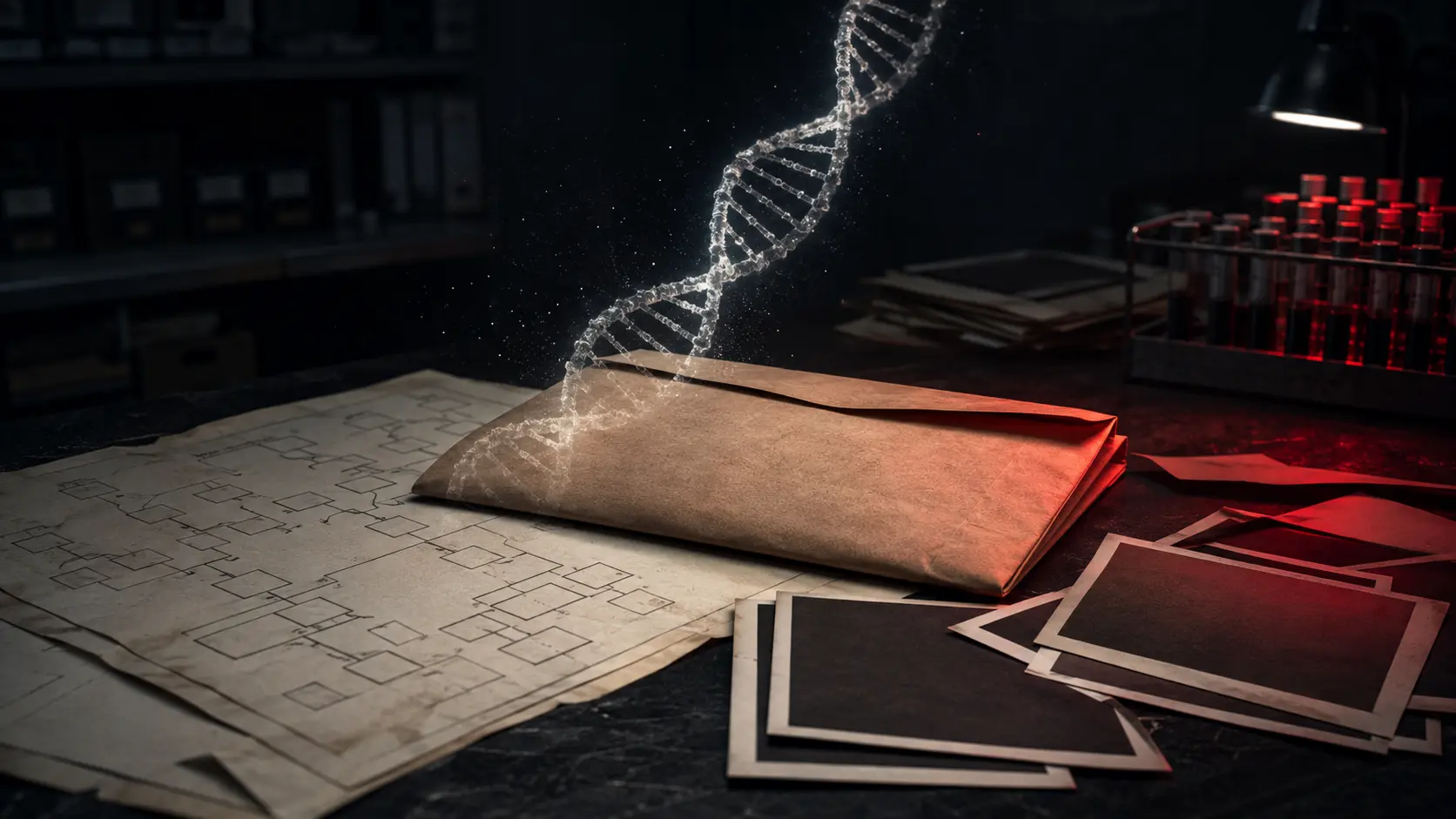

Forensic genetic genealogy combines a DNA profile developed from crime-scene evidence or unidentified remains with genealogy research and comparison in databases that permit law-enforcement use. Investigators look for genetic relatives, build family networks from public records, and narrow possible identities using age, location, sex, and case facts. The result is an investigative lead—not a conviction. A direct reference sample, conventional forensic comparison, and independent evidence are normally needed to confirm identity and establish any connection to a crime.
What to remember
- A relative’s match can point toward a family network without identifying the source person by itself.
- Genealogy databases and the government CODIS system are not the same and have different rules.
- Family trees can contain errors, nonpaternity events, adoptions, incomplete records, and duplicate identities.
- A genealogical lead should be confirmed through a legally obtained reference sample and conventional forensic testing.
- Privacy, consent, scope, data retention, and unequal representation remain central policy questions.
What forensic genetic genealogy is
Traditional forensic DNA searching commonly compares a profile from evidence with profiles in a government database under defined legal and technical rules. A direct match can link the evidence to a known person or another case. When there is no match, the profile may remain unresolved for years.
Forensic genetic genealogy, sometimes called forensic investigative genetic genealogy, uses a different type of genetic comparison and genealogy research. A profile suitable for genealogical analysis is compared in a database whose policies allow that use. Shared DNA can suggest distant or close biological relationships. Researchers then combine those relationships with records to generate possible identities.
The U.S. Department of Justice describes the technique as a way to generate leads in unsolved violent crimes and to help identify unknown human remains. The word lead is essential. Genealogy guides investigators toward questions; it does not answer every legal or scientific question on its own.
From unknown DNA to an investigative lead
The process begins with evidence that has survived collection, storage, and laboratory testing. Not every sample contains enough usable DNA, and mixed or degraded samples can complicate interpretation. A laboratory may develop a profile with many genetic markers used for relationship estimation rather than only the shorter profile used in conventional forensic databases.
Permitted database comparison may reveal users who share segments of DNA with the unknown profile. The amount and pattern of sharing can suggest possible relationships, but multiple relationships can produce similar estimates. Genealogists build trees backward to common ancestors and forward through descendants, using birth, death, marriage, census, obituary, property, and other lawful records.
Investigators narrow candidates by case facts such as age, geography, biological sex, timeline, and opportunity. A candidate is not confirmed merely because a tree fits. Authorities generally seek a direct sample and perform conventional forensic comparison. Other evidence must establish whether the person is connected to the event rather than simply related to someone in a database.
Why the method can reopen a decades-old case
A cold case may contain biological evidence collected before modern testing existed. Improved extraction and sequencing can sometimes produce information from older or smaller samples. Digitized public records make large family networks easier to research across regions and generations.
The passage of time also creates difficulty. Evidence may be consumed, contaminated, lost, or degraded. Witnesses die, memories change, names change, records remain sealed, and people move. A successful genetic lead does not restore missing context.
For unidentified remains, genealogy can reconnect a person with a name and family even when no crime is established. Identification can permit proper notification, correct records, and renewed investigation of circumstances. Reporting should distinguish human identification from suspect identification.
Why a genealogical match is not proof of guilt
People share DNA because they are related, not because they participated in the same event. A database match may lead to many descendants and collateral relatives. Family proximity can make an innocent person relevant to the research process without making them a suspect.
Even a direct forensic match establishes that biological material is consistent with a person under the laboratory’s interpretation. It does not automatically establish when or how the material was deposited, what activity occurred, or legal culpability. Transfer, mixture, context, and case-specific evidence matter.
Responsible announcements describe the method as lead generation followed by confirmation. Headlines that say genealogy solved the case may erase the laboratory, records, interviews, warrants, alibis, and conventional investigation that produced a prosecutable conclusion.
Use “generated a lead,” “helped identify,” or “was followed by confirmatory testing” when those phrases match the public record. Do not imply that a family-tree estimate alone proved guilt.
The privacy debate extends beyond the person who uploaded DNA
A person who uploads genetic data makes a choice that can reveal information about biological relatives who did not participate. A distant match may help map an entire branch of a family. That network effect makes genetic privacy different from an ordinary username or photograph.
Database policies vary. Some require affirmative opt-in for law-enforcement matching; others define eligible cases or restrict access. Policies can change, and users should review current terms rather than assuming that a consumer test and every genealogy platform operate the same way.
Policy questions include consent, notice, case severity, warrants, abandoned DNA, surreptitious collection, data retention, security, oversight, auditing, and remedies for misuse. The DOJ interim policy sets principles and limitations for federal components, but state and local rules vary.
Where genealogy research can go wrong
Family trees often contain copied errors. Names repeat, dates conflict, records refer to different people, and informal online trees may lack sources. Adoption, donor conception, nonpaternity events, remarriage, name changes, and missing records can disrupt expected relationships.
Relationship estimates have ranges. A shared amount of DNA can fit more than one genealogical relationship. Endogamy—repeated marriage within a population—can make people appear more closely related across several lines. Underrepresented populations may have fewer matches or weaker documentary records.
Good practice documents each inference, distinguishes source records from user assertions, tests alternatives, and avoids contacting families prematurely. A plausible tree is a hypothesis until genetic and documentary evidence converge.
Identifying unknown human remains
Unidentified-person investigations often begin with physical description, clothing, dental information, fingerprints, anthropology, and traditional DNA searching. Genealogy can add a new path when those methods do not yield a name.
Researchers may identify ancestral lines and compare them with missing-person records, family reports, geography, age, and life history. Relatives can be asked for reference samples through appropriate procedures. Families should receive clear information about purpose, consent, and possible unexpected findings.
Identification should be communicated by the responsible authority, not online sleuths. Premature public naming can cause profound harm and may compromise investigation or family notification.
How journalists should cover a genealogy-assisted identification
Begin with the official record: which agency announced the development, what laboratory method was described, what was confirmed, and what remains allegation. Distinguish a deceased person identified from a living person charged. Use presumption-of-innocence language unless there is a conviction.
Avoid publishing relatives’ genetic details, surprise parentage information, addresses, or speculative family trees. The existence of a database match does not make relatives public figures. Ask whether the database permitted the use and whether the agency followed a published policy, but do not expose operational details that would undermine future investigations.
Credit the full chain of work without turning science into magic. Evidence preservation, laboratory quality, genealogy, conventional investigation, family cooperation, and legal process all matter.
The future: better standards, clearer consent, cautious expectations
The method will continue to evolve alongside sequencing, record access, database policies, and law. Standardization can improve documentation, validation, practitioner qualifications, auditability, and disclosure to courts.
Better consent interfaces can help users understand choices without requiring genetics expertise. Independent oversight and transparent statistics can clarify what types of cases are eligible, how often the method succeeds, and how data is retained.
Genetic genealogy can resolve identities that once seemed unreachable. Its legitimacy will depend not only on results, but on whether those results are produced with proportionality, confirmation, privacy protection, and public accountability.
A policy checklist for proportional use
Eligibility should be clear. A policy can define which violent crimes, unidentified remains, threats, or exceptional circumstances justify genealogy and which traditional steps should be attempted first. Exceptions should be documented rather than becoming the routine.
Database use should respect current terms and user consent choices. Agencies should record which service and access mode were used, what data was uploaded, who could view it, and when it was removed or retained.
Genealogy work needs qualifications, documentation, conflict controls, and peer review. Public-record research can expose sensitive family information; access should be limited to what advances the authorized case.
Candidate selection and exclusion should be auditable. Investigators should explain how many branches were considered, what case filters were applied, and why a person became a lead. This helps detect confirmation bias.
Confirmation, disclosure, and oversight complete the process. A direct forensic comparison, legal review, defense access where required, statistics, and complaint mechanisms allow powerful results to coexist with public accountability.
Laboratory quality before genealogy begins
Genealogy cannot repair a contaminated or misattributed sample. Collection history, storage, extraction controls, mixture interpretation, and laboratory documentation remain foundational. Old evidence may have passed through standards that differ from current practice.
A genealogical profile and a conventional forensic profile serve different comparison purposes. Laboratories must document conversion, thresholds, quality, and limitations. A partial profile may produce fewer or more ambiguous relatives.
Independent review should examine whether the sample can be associated with the relevant event at all. A strong family tree built from an irrelevant sample is still an irrelevant lead.
Unexpected family information and ethical communication
Genealogy can reveal adoption, donor conception, misattributed parentage, previously unknown relatives, or family separation. These findings may be incidental to the investigation but profound for living people.
Researchers should minimize unnecessary disclosure and follow agency policy. Families asked for samples deserve a clear explanation of purpose, possible outcomes, retention, and whether results could expose other relationships.
Journalists should not publish surprise parentage or construct public family trees unless the information is essential, verified, lawful, and handled with exceptional care. Being genetically related to a subject is not public wrongdoing.
Genealogy can exclude as well as include
A proposed family line can fail when DNA sharing, ages, geography, or records do not fit. Exclusion is valuable: it prevents resources from concentrating on the wrong person and tests the quality of the working tree.
Confirmation samples should be interpreted under appropriate forensic standards. A close relative may help confirm an unidentified person, while suspect attribution generally requires a direct evidentiary comparison and legal process.
Investigators should preserve alternative hypotheses until confirmation. Public enthusiasm for a promising lead can create tunnel vision and expose innocent relatives before the science is complete.
The chain from relationship estimate to courtroom evidence
A database result begins with shared genetic segments and an estimated relationship range. It does not arrive with a verified family tree. Researchers must identify common ancestors and document descendants using records whose reliability varies by place and period.
Case filters narrow the tree. Age, sex, residence, travel, military service, employment, and family connections can exclude branches. Each filter needs a source and should be applied without forcing the tree toward a favored candidate.
When a candidate emerges, investigators need lawful confirmation. A reference sample can establish whether the candidate matches the evidence under conventional forensic analysis. The method and legal authority for obtaining that sample are separate from genealogy.
After confirmation, the rest of the case still matters. Opportunity, timeline, transfer, witnesses, digital records, motive, and alternative explanations determine what the DNA means. Biological association is not a complete narrative.
Disclosure allows the method to be tested. Reports should preserve database policies, laboratory steps, genealogy sources, candidate selection, exclusions, and confirmatory analysis while protecting unrelated relatives’ private information.
Questions people ask
Is forensic genealogy the same as CODIS?
No. CODIS is a government forensic DNA database with defined profile and eligibility rules. Genealogy comparisons use different markers and databases with separate policies.
Can police see everyone’s consumer DNA test?
No. Access depends on the platform, user choices, policies, law, and investigative process. Review each service’s current terms.
Does a relative’s match make me a suspect?
No. A match may place someone in a broad family network. Case facts and confirmatory evidence are required.
Can genealogy identify someone without a close relative in the database?
Sometimes several more distant matches can be combined with records, but success varies greatly.
Can DNA alone solve a case?
DNA can identify or associate biological material, but activity, timing, transfer, and legal responsibility require context and other evidence.
Research note: TruthTube prioritizes government publications, primary records, scientific standards, and official reporting channels. This article is educational and does not replace legal, financial, medical, or psychological advice.
This article was researched using official records, regulator notices, court documents, law-enforcement releases, provider documentation and reputable reporting. Material claims were checked against the cited sources.
AI tools may have assisted with research organization, language refinement, transcription or illustration, but factual claims were reviewed by Lavi, Founder & Editorial Lead.
Published July 11, 2026. This page is scheduled for review when official guidance, reporting channels, scientific standards, or relevant laws change.